Void Fill Guide: Packing Peanuts vs Foam Wrap vs Honeycomb Paper
Key Takeaway
Packing peanuts fill gaps fast, foam wrap stops scratches and honeycomb paper cushions without plastic. Here's which void fill to use, and when to use two together.
Open a returned parcel and you can usually tell what went wrong. The item has slid to one corner, there's a chip on the edge that hit the box wall, and the packing material is all bunched up at the other end.
Most of the time the box was fine. The problem was what went inside it. Void fill has two jobs: stop the item moving, and cushion the surfaces that touch something hard. Packing peanuts, foam wrap and honeycomb paper each do one of those jobs better than the others, and picking the wrong one is how good boxes end up with broken contents.
Short answer
Use loose fill (packing peanuts) to fill empty space fast around odd shapes. Use foam wrap to stop scratches on polished or painted surfaces. Use honeycomb paper when you want to wrap and cushion without plastic. Many packers use two: wrap first, then fill the gaps.
Packing peanuts (loose fill): for filling gaps fast
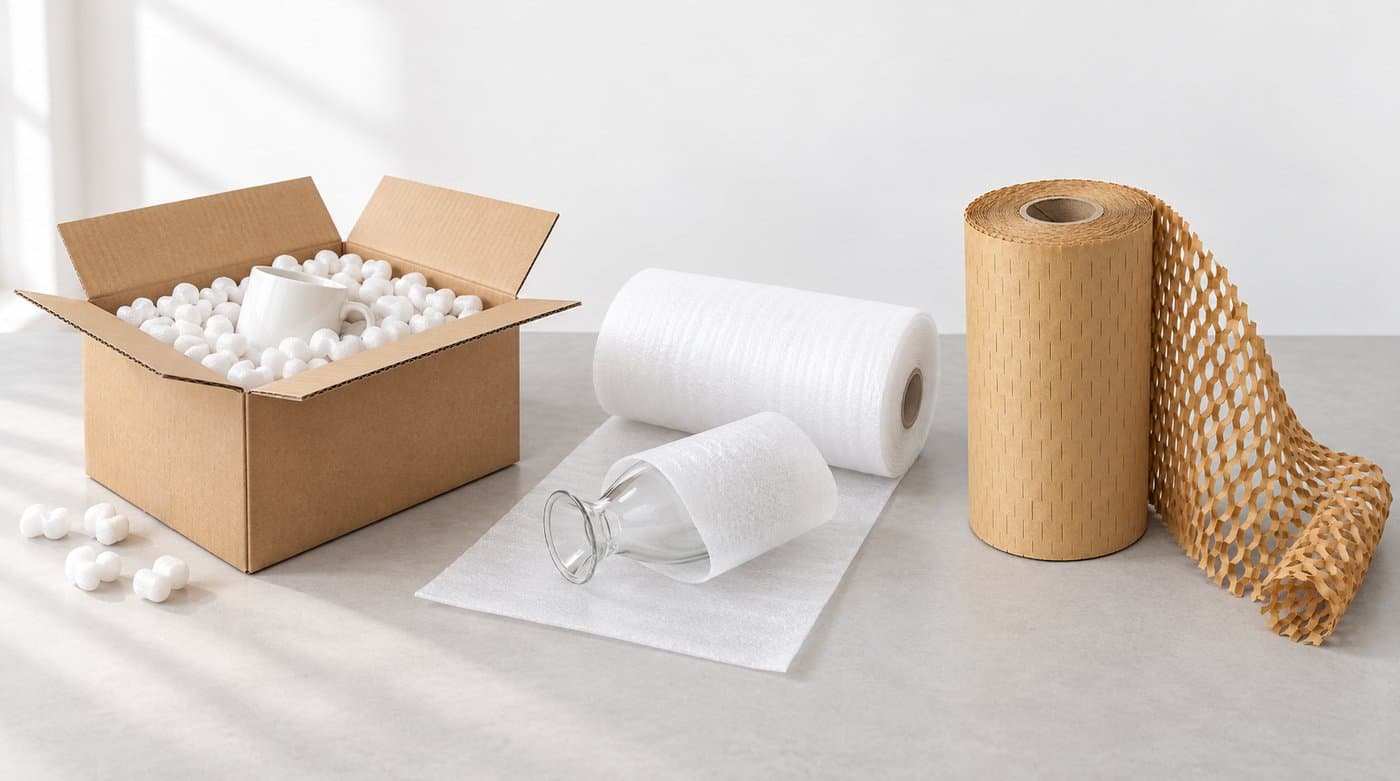
Loose fill is the quickest way to fill a box. You pour it in around the item until nothing can move, and it flows into corners and around handles and spouts that are awkward to wrap. It's light, so it adds very little to the parcel weight.
It comes in large 15 cubic foot bags (about 425 litres), which goes a long way. For scale, a 305 × 229 × 229 mm box holds about 16 litres in total, so one bag fills the spare space in a lot of parcels. We sell three types:
- Polystyrene loose fill. Expanded polystyrene (EPS), the lightest of the three at about 1.8 kg per bag. It doesn't break down, but it's tough enough to be reused many times.
- Bio loose fill. Made from GM-free corn starch, about 3.2 kg per bag. It's compostable and dissolves in water, so your customer can get rid of it without guilt.
- Bio Ultra loose fill. Heavy-duty starch-based blue chips with added natural polymers, about 3.5 kg per bag, for when you want a starch-based fill with more body.
Where it lets you down: heavy items can work their way down through the peanuts during transit and end up resting on the bottom of the box. Put a layer in first, sit the item on it, then fill around and on top, and shake the box gently so the fill settles before you seal it.
Foam wrap: for scratch-free surfaces
Foam wrap is a soft, clean sheet you wrap around the item before it goes in the box. Our Jiffy foam rolls are low density closed-cell polyethylene, in thicknesses from 1.0 mm to 4.0 mm.
- 1.0 to 1.5 mm: a surface layer. Stops scuffs and scratches on polished metal, painted panels, glass and screens.
- 2.5 to 4.0 mm: more cushioning, for heavier items and furniture where knocks matter as much as scratches.
Where it lets you down: foam protects the surface, but it doesn't fill the box. A wrapped item still slides around in a box that's too big, so pair it with loose fill or crumpled paper for the gaps.
Honeycomb paper: plastic-free wrap
Honeycomb paper (sold here as Hivewrap) arrives as flat kraft paper on a roll. It's 80 gsm, die-cut with rows of short slits, and when you pull a length off the roll it stretches open into a 3D mesh of cells. Wrapped around an item, the cells nest into each other and hold on without tape.
It's paper, so it goes in the paper recycling with the box. Rolls are 250 metres long, in 400 mm and 500 mm widths.
Where it lets you down: it cushions well, but it's a wrap, not a filler. For a big box with lots of empty space you'll still want something to stop the wrapped item moving.
Side by side
| Loose fill | Foam wrap | Honeycomb paper | |
|---|---|---|---|
| Main job | Fills empty space | Protects surfaces | Wraps and cushions |
| Material | EPS, or corn starch based | Closed-cell polyethylene | 80 gsm kraft paper |
| Plastic-free | Bio and Bio Ultra: starch based. Polystyrene: no | No | Yes |
| After use | Bio dissolves in water and composts; polystyrene can be reused | Recyclable LDPE where collected | Paper recycling |
| How it's sold | 15 cu ft bags (about 425 litres) | Rolls, 1.0 to 4.0 mm thick | 250 m rolls, 400 or 500 mm wide |
| Best for | Odd shapes, multi-item boxes, big gaps | Polished, painted or glass surfaces, furniture | Glassware, ceramics, cosmetics, gifts |
The quick verdict
- Go with loose fill if you pack lots of different shapes and need to fill space quickly on a busy bench.
- Go with foam wrap if a scratch would ruin the item: polished metal, paintwork, screens, furniture.
- Go with honeycomb paper if your customers expect plastic-free packaging, or you ship glass and ceramics that need a cushioned wrap.
- Use two together for fragile items in a roomy box: wrap first, then fill the gaps so nothing moves.
If your items fit their boxes snugly and arrive fine, you may not need void fill at all. Getting the box size right is often the cheapest protection there is.
Questions we get asked
What is void fill?
Anything that fills the empty space in a box so the item can't move in transit. Packing peanuts are the classic example; paper and air-based fillers do the same job.
Are packing peanuts biodegradable?
It depends on the type. Our Bio loose fill is made from corn starch; it's compostable and dissolves in water. Polystyrene peanuts are not biodegradable, but they can be reused many times.
Is honeycomb paper as good as bubble wrap?
They do a similar job in different ways. Honeycomb paper cushions through its stretched cells and holds itself in place without tape, and it's plastic-free. Bubble wrap is lighter and water resistant. For glass and ceramics, either works when you use enough layers.
What thickness of foam wrap do I need?
For scratch protection only, 1.0 to 1.5 mm is enough. For heavier items or furniture, where knocks matter too, go for 2.5 or 4.0 mm.
Ready to order packaging featured in this guide?
Explore full sizing specs, volume discount tiers, and instant pallet pricing in our live catalog matrix.
Related Technical Guides
Boxes vs Mailing Bags vs Padded Bags: Which to Use
Single vs Double Wall Boxes: How to Choose
How to Ship Clothes: Mailing Bags and Grip Seal Bags